
Choosing the right chicken breed for your backyard flock is one of the most exciting and important decisions you’ll make as a poultry keeper. Two of the most beloved dual-purpose breeds among backyard chicken enthusiasts are the Speckled Sussex and the Plymouth Rock. Both are hardy, friendly, and productive, but they offer distinctly different personalities, appearances, and strengths. In this detailed speckled sussex vs plymouth rock comparison, we’ll break down everything you need to know from egg production and temperament to foraging ability and cold hardiness so you can decide which breed deserves a spot in your coop.
If you’re considering adding a rooster to your flock, check out details on the Speckled Sussex rooster and the Plymouth Rock chicken breed overview. For more on egg-laying potential, our guide on Speckled Sussex egg production has you covered.
A Quick Overview of Each Breed
Speckled Sussex: The English Heritage Breed
The Speckled Sussex is one of the oldest domesticated chicken breeds, originating in England over 1,000 years ago. Originally bred as a table bird, the Sussex was prized for its ability to put on weight quickly while still laying a respectable number of eggs. The speckled variety with its striking mahogany feathers tipped in white is the most popular color variation today. For an in-depth look at the breed, visit our complete guide on Speckled Sussex Chickens.
These birds are medium-to-large, with broad bodies, white skin, and a calm, curious demeanor that makes them wonderful backyard companions. They’re known for their chatty, friendly nature and their enthusiasm for free-ranging.
Plymouth Rock: The American Classic
The Plymouth Rock, particularly the Barred Plymouth Rock (often simply called the “Barred Rock”), is an American breed developed in the mid-19th century in Massachusetts. It was one of the foundation breeds of the American poultry industry and remains a staple in backyards across the country. Plymouth Rocks are dual-purpose birds known for their steady egg production, excellent meat quality, and famously calm temperament.
With their striking black-and-white barred plumage, yellow legs, and full, sturdy bodies, Plymouth Rocks are as beautiful as they are practical.
Appearance: Beauty in the Eye of the Beekeper(Speckled Sussex and Plymouth Rock)
Let’s be honest: both breeds are gorgeous, but in very different ways.
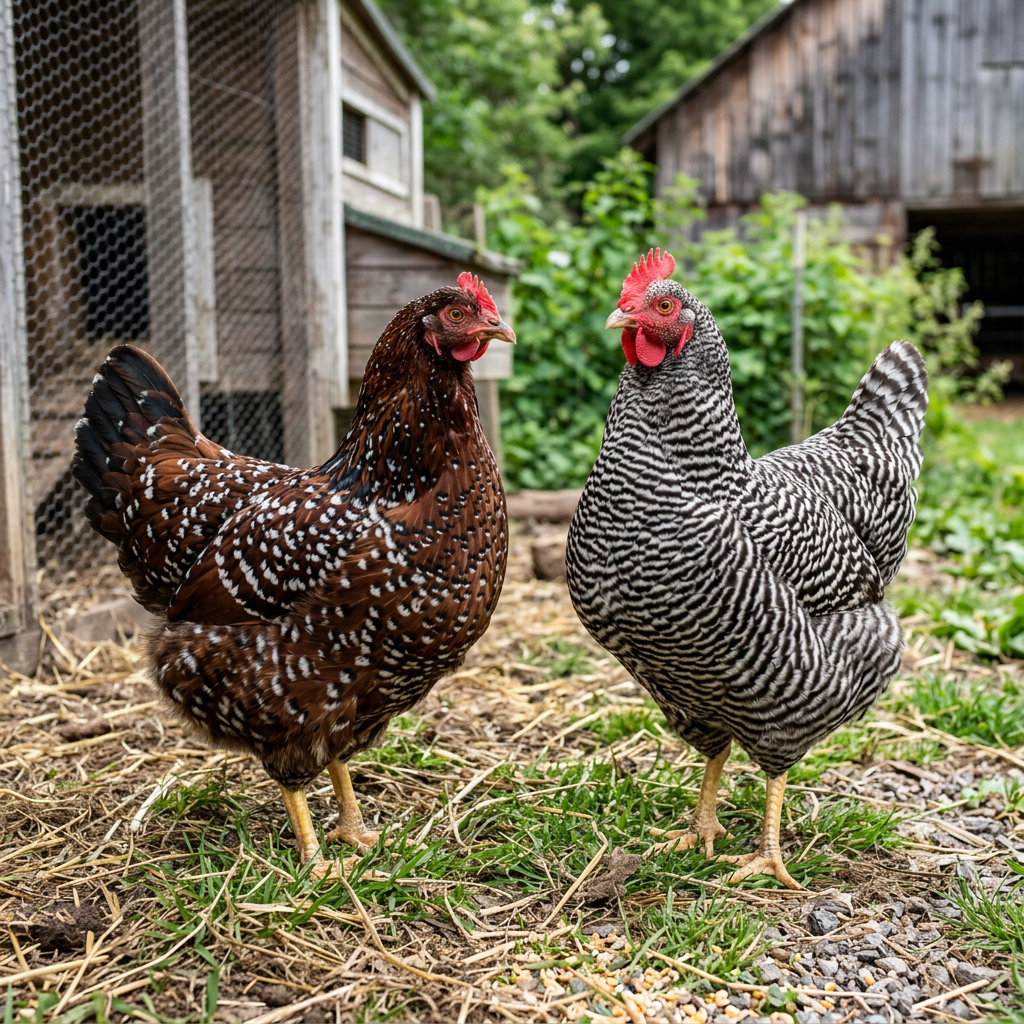
The Speckled Sussex sports a rich, warm mahogany base color with each feather tipped in white, creating a beautiful “speckled” effect that only becomes more pronounced with each molt. As the bird ages, the speckling becomes denser and more striking. They have a single red comb, white legs, and a rectangular, broad body shape. Speckled Sussex chicks are a lovely buff color with distinct brown striping down their backs, making them easy to identify from day one.
The Plymouth Rock is best known for its barred plumage, alternating light and dark bands that give the bird a blue-gray appearance from a distance. The barred variety is the most common, but Plymouth Rocks also come in white, buff, silver-penciled, partridge, and several other color varieties. They have a single red comb, yellow legs and skin, and a long, broad back with a deep, full breast.
Winner: A tie; it comes down to personal preference. If you love warm, speckled tones that evolve over time, go Speckled Sussex. If you prefer classic barred patterns and clean lines, the Plymouth Rock is your bird.
Temperament: Who’s the Friendlier Flock Member?
Both breeds are celebrated for their docile, friendly temperaments, making them excellent choices for families with children and first-time chicken keepers.
Speckled Sussex chickens are curious, chatty, and love being part of the action. They tend to bond closely with their owners and will happily follow you around the yard hoping for treats. Hens are gentle and non-aggressive, and roosters, while protective, are generally manageable compared to more hot-tempered breeds. The Speckled Sussex is known for its intelligence and can even learn to come when called. They are not flighty and enjoy being handled, which makes them great for kids. You can learn more about keeping a rooster in our Speckled Sussex Rooster guide.
Plymouth Rocks are often described as the “golden retrievers” of the chicken world. They are calm, sweet-natured, and incredibly easy to handle. Barred Rocks (a common nickname) rarely show aggression toward humans or other flock members. They are docile without being timid, curious without being flighty, and adapt well to both confinement and free-range life. Plymouth Rocks tend to be a bit more laid-back and less vocal than Speckled Sussex, which some keepers prefer.
Winner: Both are exceptional. Speckled Sussex wins if you want a more interactive, chatty companion. Plymouth Rock wins if you want an ultra-calm, low-drama flock member.
Egg Production: Which Breed Lays More?
For many backyard keepers, egg production is the deciding factor. Let’s see how these two breeds compare in the speckled sussex vs plymouth rock egg-laying matchup.
Speckled Sussex hens are reliable layers, producing around 200–250 large, light brown eggs per year. They typically start laying at around 20–24 weeks of age. While not the most prolific layers in the chicken world, they are consistent throughout the year and lay well even through colder months thanks to their hardy constitution. For detailed numbers and year-round expectations, check out our page on Speckled Sussex Egg Production.
Plymouth Rock hens are slightly more productive, laying around 200–280 large brown eggs per year. They also begin laying at about 20–24 weeks of age. Plymouth Rocks are known for being steady, reliable layers that produce eggs consistently across seasons, with only a slight dip during the darkest winter months.
Winner: Plymouth Rock edges ahead by about 30–40 eggs per year, but the difference is modest. Both are excellent brown-egg layers for a backyard flock.
Meat Production: Dual-Purpose Capabilities
Both the Speckled Sussex and the Plymouth Rock were originally developed as dual-purpose breeds, meaning they perform well for both egg and meat production.
The Speckled Sussex was historically prized as a table bird in England. It matures to a good size — hens weigh around 7 pounds and roosters around 9 pounds. The breed is known for putting on weight easily and has broad, meaty breasts with white skin, which is preferred in many markets.
The Plymouth Rock is slightly larger on average. Hens weigh around 7–8 pounds and roosters around 9–10 pounds. The breed has a deep, full breast and a well-fleshed carcass. Plymouth Rocks were instrumental in the development of the modern broiler industry.
Winner: Plymouth Rock has a slight edge in size and meat yield, but Speckled Sussex is no slouch in this department either.
Hardiness: Weather and Health of Speckled Sussex and Plymouth Rock
When it comes to the speckled sussex vs plymouth rock question of hardiness, both breeds shine, but in different conditions.
Speckled Sussex chickens are exceptionally cold-hardy. Their dense, soft feathers provide excellent insulation, and their single comb, though susceptible to frostbite in extreme cold, is proportionate and manageable. They originated in the English climate, which is damp and cool, so they handle wet, cold conditions admirably. They are also good foragers and can thrive on pasture with minimal supplemental feed during warmer months.
Plymouth Rocks are equally cold-hardy and arguably even more adaptable. Their single comb is moderately sized and less prone to frostbite than larger combs. Plymouth Rocks have a thick, fluffy feather coat and a sturdy body that holds heat well. They adapt equally well to hot and cold climates, making them one of the most versatile breeds available. They are also known for being healthy, long-lived birds with few genetic health issues.
Winner: Both are winners in hardiness. Plymouth Rock has a very slight edge in heat tolerance and overall adaptability, while Speckled Sussex excels in cold, damp climates.
Foraging Ability: Free-Range Performance
If you plan to let your chickens free-range, their foraging ability matters.
Speckled Sussex chickens are excellent foragers. Their history as a farmyard breed in England means they are naturally inclined to scratch, hunt, and explore. They will happily supplement their diet with bugs, greens, and seeds, which reduces your feed costs and produces richer, more flavorful eggs.
Plymouth Rocks are also good foragers, though not quite as enthusiastic as the Speckled Sussex. They will happily free-range and find a good portion of their diet, but they are slightly more content to stay close to the coop and accept supplemental feed.
Winner: Speckled Sussex takes the foraging crown. If you want a bird that will truly live off the land, the Speckled Sussex is the better choice.
Broodiness: Which Breed Is More Likely to Go Broody Speckled Sussex , Plymouth Rock?
Broodiness, the instinct to sit on and hatch eggs, can be a blessing or a challenge depending on your goals.
Speckled Sussex hens have a moderate tendency to go broody. They make attentive, protective mothers and are excellent at hatching and raising chicks. If you want to naturally expand your flock, the Speckled Sussex is a solid choice.
Plymouth Rock hens are less broody on average. While some individual hens may go broody, it is less common than with the Speckled Sussex. This is an advantage if you want uninterrupted egg production without dealing with a broody hen taking over a nesting box.
Winner: Speckled Sussex if you want a natural mother for hatching chicks. Plymouth Rock if you want uninterrupted laying.
Availability and Cost for Speckled Sussex and Plymouth Rock
The Speckled Sussex is a popular breed but can be harder to find than Plymouth Rocks, especially in rural areas. Many hatcheries carry them, but they may sell out quickly during spring ordering season. Pricing is typically moderate, comparable to other heritage breeds. If you’re looking to add them to your flock, you can find Speckled Sussex Chickens For Sale and Sussex Rooster For Sale to get started.
The Plymouth Rock is one of the most widely available chicken breeds in the United States. Almost every hatchery and feed store carries them, particularly the Barred variety. They are generally affordable and easy to source, with chicks available throughout the spring and summer. For those specifically interested in the barred variety, check out Barred Rock Chicks For Sale.
Winner: Plymouth Rock wins on sheer availability and ease of sourcing.
Coop and Space Requirements for Speckled Sussex and Plymouth Rock
Both breeds are medium-to-large chickens that need adequate coop space. Standard recommendations apply: at least 4 square feet per bird inside the coop and 8–10 square feet per bird in the run.
Speckled Sussex birds are active and curious. They benefit from larger runs or free-range access where they can explore and forage. They are not particularly prone to flying, so standard 4–5 foot fencing is usually sufficient.
Plymouth Rocks are slightly heavier and less flighty than Speckled Sussex. They are content in confined spaces as long as they have enough room, though they too prefer free-range access. Their calm temperament makes them easier to keep in smaller runs without developing behavioral issues.
Winner: Both are similar. Plymouth Rock adapts slightly better to confinement.
Which Breed Should You Choose? Speckled Sussex vs Plymouth Rock
Ultimately, the speckled sussex vs plymouth rock decision comes down to what you value most in a backyard chicken.
Choose the Speckled Sussex if:
- You want a strikingly beautiful, conversation-starting bird
- You value interactive, chatty, curious personalities
- You plan to free-range and want excellent foragers
- You want a hen that may go broody and raise chicks naturally
- You live in a cool, damp climate
- You appreciate heritage breeds with deep history
Choose the Plymouth Rock if:
- You want the most reliable, steady egg production
- You prefer a calm, ultra-docile, low-drama temperament
- You need a breed that adapts well to both confinement and free range.
- You want a bird that handles both heat and cold with ease
- You’re a first-time chicken keeper looking for the easiest possible breed
- You value wide availability and affordability
Final Thoughts on Speckled Sussex vs Plymouth Rock
Both the Speckled Sussex and the Plymouth Rock are outstanding choices for a backyard flock. You honestly can’t go wrong with either breed or both! Many keepers find that the combination of a chatty, speckled beauty and a calm, barred classic creates the perfect balanced flock.
Whether you choose the rich, speckled plumage of the Sussex or the iconic barred pattern of the Plymouth Rock, you’re getting a healthy, productive, and friendly bird that will bring years of joy to your backyard. If you’re ready to start or expand your flock, explore our selection of Speckled Sussex Chickens and other premium breeds to find the perfect additions to your coop.
For more information on chicken breeds, egg production, and backyard flock management, explore additional resources at The Livestock Conservancy and BackYard Chickens, two trusted sources for poultry enthusiasts.